
Solutions / Defense primes
Every sub on your award has a different set of obligations.AutoSAM tracks all of them, for every sub, at once.
Flow-down obligations vary by clause, by sub, by tier. A spreadsheet cannot hold that shape at scale; the obligation engine can.
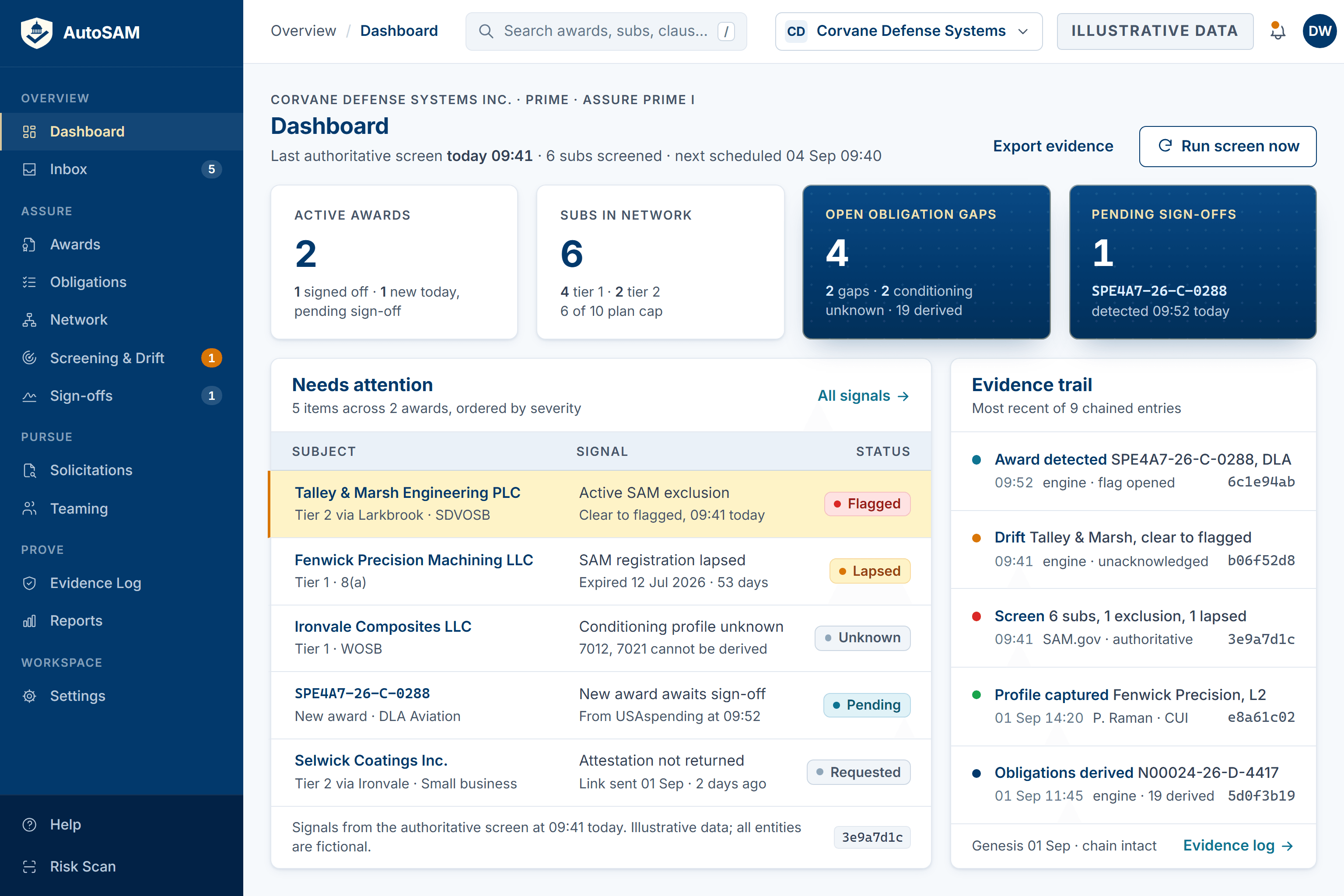
Product concept preview · illustrative data, fictional entities
Prime dashboard
A fictional prime’s two awards and six named subs: the obligation gaps derived from the flowed clauses, one exclusion flagged, and the evidence trail behind every screen.
The exposure
The government flows the obligation down. It does not map it for you.
Your award names the clauses. It does not tell you which of your subs owes what under each one. Deriving that map across an active-award network is your responsibility, and the review that finds the gap assumes you already did it.
One obligation engine
Five obligation streams. Every named sub. One derivation rail.
The engine behind Assure, Pursue, and Prove, pointed at your own sub network: awards in, derived obligations out, and a screening record for every named sub across all five obligation streams.
Your award
Derived obligations
Each named sub
Per-sub conditioning
Screened against what each sub actually owes.
Per-sub conditioning profiles mean a Tier 1 8(a) sub and a Tier 3 large-prime sub on the same award are screened against what each of them actually owes, not a template built for neither.
CMMC flow-down
DFARS / FAR clauses
FASCSA orders
Exclusion duty (FAR 9.405)
Sub-plan goals (FAR 19.7)
Founding Cohort
Start with the awards you already hold.
AutoSAM derives the obligation map from your live award portfolio and the subs already named in it, then keeps the screening record current for every one of them. No document uploads, no questionnaires sent to your subs.